
Congress has authorized a similar commission for each of the four major milestones of the Declaration of Independence, from the centennial in 1876 through the sesquicentennial in 1926 and the bicentennial in 1976 to the present semiquincentennial. The apparatus points steadily toward July 1776 as the origin the country is marking.
The founding event is the starting point of a much longer process. What has persisted for 250 years is not only that starting point but everything that grew from it.
A group of fewer than sixty delegates in Philadelphia produced a written text over a single summer in 1787. The intervening two and a half centuries produced everything that grew from that text: statutes contested through generations of amendment fights, court decisions written by successive judges applying earlier decisions to new facts, federal agencies issuing rules that survive or fail on judicial review, and negotiated arrangements between state governments, federal regulators, and private actors that harden into the working shape of American governance.
A serious account of what has lasted therefore takes in more than the parchment. It takes in the ecosystem of derived institutions that grew from that parchment across two and a half centuries, and it asks what mechanism has allowed the arrangement to hold.
American Governance at 250 Years
- The United States Semiquincentennial Commission, established by Congress in 2016, coordinates official commemoration of 250 years since the Declaration of Independence.
- The 1787 Constitution runs seven articles and 27 amendments, and functions as an anchor within a long derivation chain rather than a comprehensive legal code.
- Four semi-independent domains account for most working American governance: legislation, judicial and common law, administrative law, and negotiated equilibria between government and private actors.
- The Administrative Procedure Act of 1946 established the default procedures for federal agency rulemaking and judicial review, and is a principal instance of accretion on the constitutional anchor.
- Joseph de Maistre argued in 1796 that legitimate constitutions cannot be deliberately drafted, and the American case complicates his framework without simply overturning it.
- The durability associated with age depends on continued adversarial contest across the accretion tracks.
The written anchor and the derivation chain it carries
The 1787 Constitution is a short document. Its main text runs seven articles, and the National Archives records 27 amendments ratified across the subsequent two centuries. Even the most litigated provisions of that text, including the equal protection clause and the due process clause, are single sentences. Most of what those sentences mean in current practice is the product of judicial interpretation applied across specific cases.
The document's role in the American arrangement is closer to that of an anchor than a comprehensive legal code. Nearly every institution operating today can trace its authority back to it through a chain of derivation. A federal regulation traces to a statute passed by Congress, which traces to a specific grant of legislative power in Article I. A state court's application of common law sits within the federal structure the founding document establishes.
The Constitution's brevity is what enables that derivation. A more specified text would foreclose more of the decisions that later actors need to make. The written document sets the terms under which subsequent actors, including courts, legislatures, and agencies, would produce the rest of the arrangement.
It anchored a system without attempting to specify it.
The Reconstruction Amendments, ratified between 1865 and 1870, extended the same pattern at a moment of maximum stress. According to a 2004 essay by Eric Foner published by the Gilder Lehrman Institute, the Thirteenth, Fourteenth, and Fifteenth Amendments transformed the Constitution's operational scope, yet the amendments themselves are compact.
The Fourteenth Amendment's guarantee of equal protection runs a few dozen words. Its operational meaning was elaborated across the following century in judicial decisions such as Brown v. Board of Education in 1954, and reinforced by civil rights legislation in the 1960s. The amendment set the terms; the subsequent case law and statute did the specifying.
More Public Affairs Articles



The tracks that grew around the anchor
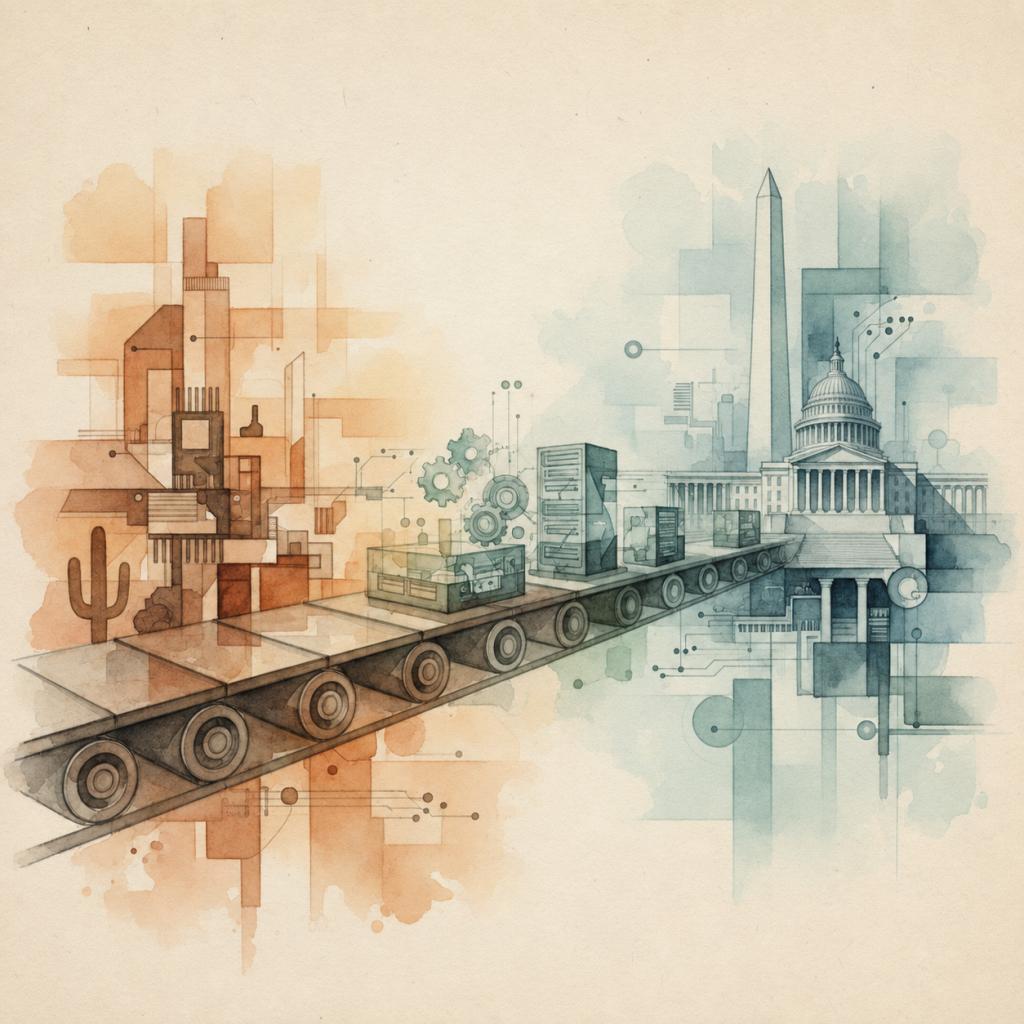
Four broad tracks account for most of the working substance of American governance today. Each is semi-independent of the others. Each has its own procedures and its own history of contest. And each traces its authority to the founding document while performing most of its actual work elsewhere.
Statute is the first track. Congress writes laws that are challenged in court, amended by later Congresses, repealed after prolonged fights, or narrowed and expanded by the agencies applying them. State legislatures produce the same dynamic at their level. A statute becomes durable when it survives multiple attempts at repeal or amendment, when opposing parties with genuine interests have tried and failed to dislodge it, and when courts have consistently declined to strike it down.
The judiciary is the second track. It includes both constitutional case law and the substantially larger body of common law that judges have developed across state and federal systems. Common law accumulates through the adversarial resolution of specific disputes between parties with opposing interests and, often, significant resources on the line. A precedent survives because subsequent courts continue to apply it, and because subsequent litigants have not managed to distinguish or overturn it.
The primary fields of American common law, including tort, contract, property, and much of criminal procedure, developed through this process across the nineteenth and twentieth centuries, and are administered principally by state courts.
Administrative law is the third track, and it grew explicitly on top of the constitutional text in the twentieth century. Federal agencies did not exist in their current form when the Constitution was drafted. The Administrative Procedure Act of 1946, described in a Congressional Research Service overview, established the default procedures under which agencies now issue rules, adjudicate cases, and face judicial review.
Since 1946, the majority of federal regulations have been produced through what the Act calls informal or notice-and-comment rulemaking, subject to challenge in federal court under the Act's judicial review provisions.
The fourth track is negotiated equilibrium between government and private actors. Its architecture is less formal than the others. Its operational weight is comparable. Private firms and their trade associations negotiate with regulators over the shape of rules before those rules are formally issued. State agencies and federal agencies work out overlapping jurisdictions through interagency understandings that become the practical governance of specific sectors.
Public-private contracting arrangements, in defense procurement, in infrastructure, and in social services, produce durable governance that no legislature has voted on directly.
A drafted constitution and Maistre's puzzle
The durability of this arrangement is anomalous by one influential line of European conservative thought. Joseph de Maistre, writing in Considérations sur la France in 1796, argued that a legitimate constitution is not the product of deliberate drafting. Real political order, on Maistre's account, is the slow deposit of custom and prescription, unavailable to be produced by any assembly attempting to compose it from first principles.
Maistre's target was the successive constitutions of revolutionary France, each of which was drafted, promulgated, and then discarded within a few years. His broader claim, as characterized in the Stanford Encyclopedia of Philosophy's entry on conservatism, was that political order is not created by written documents but accumulated through custom and long usage, and that a constitution divorced from a people's existing practice carries no real authority.
America is the case Maistre's framework does not obviously predict. A deliberately drafted text, produced over a summer in Philadelphia by fewer than sixty delegates, has served as the anchor of a functioning political order for 250 years. The resolution of the puzzle sits in the relationship between the anchor and the accretion.
The written text carried little of the legitimating weight on its own. What accumulated around it, the case law, the amendments, the statutes, the agency practice, ran in exactly the adversarial, non-deliberate, decades-long fashion Maistre argued only unwritten tradition could produce.
The Civil War and the Reconstruction Amendments qualify this picture. According to a 2001 article by John Harrison in the University of Chicago Law Review, serious objections were raised at the time about the legality of the ratification proceedings, and the amendments' formal validity remains a subject of academic debate. The rupture of the 1860s produced formal changes to the anchor itself, alongside the accretion around it.
That episode is the closest the American arrangement has come to the kind of breakdown Maistre predicted for drafted constitutions, and its resolution required a war followed by a decade of Reconstruction.
The commemorative apparatus organized around the semiquincentennial marks the founding text and its authors. The Mint's coinage program, the Field Trip contests coordinated by the Commission, and the time capsule scheduled for burial at Independence Mall all point steadily to Philadelphia in July 1776. That marking is accurate as far as it goes.
The founding is what set the terms.
If what has actually lasted 250 years is the accretion under those terms, the more consequential question at the anniversary concerns whether the accretion mechanism is still functioning. The tracks that produced American durability, statute contested through repeal fights, common law built by parties who could actually lose, administrative rules tested by judicial review, negotiated equilibria between government and private actors, require adversarial energy at every stage.
When that energy declines, when a track begins to run on inertia rather than contest, the durability associated with age becomes a form of coasting.
Whether specific statutes are still being genuinely contested, whether administrative rules face substantive rather than pro forma judicial review, whether common law is still being developed by parties with real stakes, whether federal and state governments continue to work out their overlapping jurisdictions through actual disagreement, each is a distinct empirical question.
Time alone has never been the source of the arrangement's legitimacy. What has held it together is continued use, by parties willing to contest it. The question at 250 years is less about the age of the founding document than about whether that ongoing contest is still active across each of the tracks that grew from it.
Sources
- National Archives and Records Administration. "The Constitution: Amendments 11-27." National Archives, 2025.
- Congressional Research Service. "Congressional Involvement in the Celebration of Anniversaries of the Declaration of Independence (R48473)." Library of Congress, 2025.
- Congressional Research Service. "Judicial Review Under the Administrative Procedure Act (LSB10558)." Library of Congress, 2020.
- Eric Foner. "The Reconstruction Amendments: Official Documents as Social History." Gilder Lehrman Institute of American History, History Now, Issue 2, 2004.
- Hamilton, Andy. "Conservatism." Stanford Encyclopedia of Philosophy, Fall 2025 Edition.
- John Harrison. "The Lawfulness of the Reconstruction Amendments." University of Chicago Law Review, Vol. 68, 2001.
- National Constitution Center. "Periods of Constitutional Change and the 27 Amendments." National Constitution Center, 2023.
- U.S. Government Publishing Office. "America's 250th Anniversary." GovInfo, 2026.
Article Credits