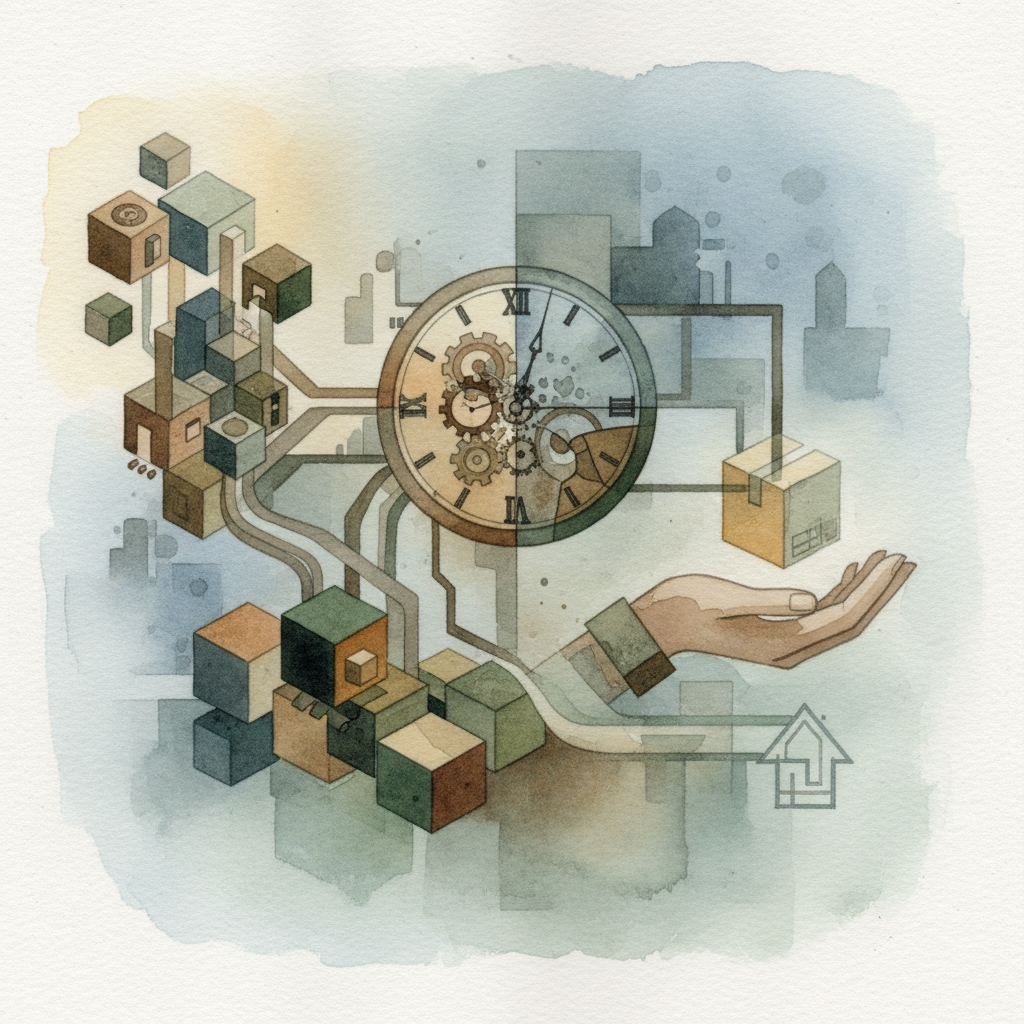
The arrangement, described by Muzak Archives, was promoted as a way to counter fatigue and support steady productivity on factory floors and in offices.
Similar sequencing principles now shape how social media feeds refresh, but the connection between these eras is rarely made explicit. From factory loudspeakers to algorithmic timelines, the common element is sequence design: structuring the order of items to reduce the likelihood that audiences turn away.
Key Developments in Sequenced Engagement
- Muzak’s 1950s Stimulus Progression cycled 15-minute musical ramps to sustain worker energy
- Seeburg’s 1959 1000 player shipped themed record libraries tailored to setting and tempo
- Radio stations used data-driven sequencing to turn unfamiliar hits into habits, lowering tune-out rates
- Raymond Williams framed television’s uninterrupted “flow” as programming’s core design unit
- Facebook and TikTok personalize those flow principles with per-user ranking based on live feedback
- Reinforcement-learning research links variable social rewards to habit-like engagement patterns
Background Music as Industrial Interface
Muzak's Stimulus Progression was marketed on the premise that stimulus intensity could be aligned with predictable dips in alertness across the workday. Company-funded studies cited by the archives reported productivity and morale gains in workplaces that adopted the format.
The timed ramps were intended to provide a sense of steady movement during repetitive shifts without demanding active attention.
Seeburg pursued a similar goal with hardware rather than leased lines. Its 1000 Background Music System, introduced in 1959, held up to 28 nine-inch discs spinning at 16⅔ RPM, with roughly 40 minutes of music per side, long enough that managers could leave the device unattended.
According to the Seeburg 1000 archive site, operators received quarterly boxes labeled Basic, Mood, or Industrial, each associated with offices, retail environments, or factories.
The Industrial library emphasized medium-fast, lively music, including polkas and other upbeat styles, to encourage a brisk pace. The Mood library used slower, string-heavy arrangements to create a calmer atmosphere, while Basic sat between them as a mid-tempo office soundtrack.
The central design unit was not individual taste but an environment in which attention, mood, and pace were treated as variables that could be adjusted through record series and delivery schedules.
Both Muzak and Seeburg showed that audience engagement could be influenced without personal data about listeners. Control rested in carefully constructed tempo curves, intensity changes, and predictable silences that reset attention.
Once better audience feedback became available, similar sequencing logic moved into broadcast media.
More Technology Articles
Radio Discovers the Feedback Loop
Broadcast radio could not personalize music to individuals, but ratings diaries and electronic measurement made audience departures visible as tune-out rates. Charles Duhigg’s account in The Power of Habit describes how OutKast’s 2003 single "Hey Ya!" initially caused 26.6 percent of listeners at Philadelphia station WIOQ to change the station when it aired.
Programmers responded by placing the track between highly familiar hits rather than playing it in isolation. Duhigg reports that after WIOQ began this pattern, the tune-out rate fell to 13.7 percent by October and 5.7 percent by December.
The playlist used known favorites as anchors so that a novel song could become familiar without prompting as many listeners to leave.
What changed was less the inventory of music than the cadence of exposure, with sequence used to manage the risk that unfamiliar tracks would trigger audience loss.
Muzak’s steady ramps targeted boredom during repetitive work, while radio sequencing targeted resistance to change among listeners with established habits. Together they showed that ordering content can either dampen or concentrate surprise depending on commercial objectives.
Television Turns Sequence into Flow
As television ownership expanded in the 1950s, broadcasters confronted the practical problem that viewers could change channels at any moment, taking entire advertising blocks with them. Cultural theorist Raymond Williams later described the industry response with the concept of "flow," arguing that the defining unit of television was not a single program but the continuous sequence of programs, promotions, and commercials across an evening.
In Williams’s account, schedulers arranged genres, time slots, and promotional spots so that each element led into the next and encouraged ongoing viewing rather than discrete tune-in and tune-out events.
The schedule became a designed path that treated the viewing session as the primary object of planning instead of the individual episode.
Television added visual tools to this sequencing, including standardized opening themes, closing credits, and station idents that bridged segments. These transitions supported the perception of continuity and made it easier for audiences to stay with a channel across multiple formats and advertising breaks.
By the 1980s, this approach had matured into tightly managed evening lineups designed to retain audiences across entire commercial pods. Flow functioned as a system-wide rhythm for broadcast networks, comparable in intent to the workday cycles in Stimulus Progression but applied to a mass audience over longer intervals.
Personalized Feeds, Personalized Progressions
Social platforms adapted the idea of flow to individual users and tied it directly to interaction data. In a 2018 News Feed update, Meta explained that Facebook would give higher rank to posts "that spark conversations and meaningful interactions between people," using signals such as reactions, comments, and shares to predict which items should appear higher in the feed, as described in the Meta newsroom.
TikTok’s For You feed extended this approach with short video. A 2020 post in the TikTok Newsroom explains that the recommendation system ranks videos using factors such as likes, shares, comments, follows, and watch time, and that a strong indicator of interest, including whether a viewer finishes a longer video, receives greater weight than weaker indicators.
The same post notes that users can send negative signals like "Not Interested," which also feed into ranking.
In both systems, each interaction updates the model that determines subsequent ranking. A comment, a share, or a full watch of a video can change which items appear next, creating many small, user-specific progressions rather than a single schedule for an entire city or nation.
Engineering work on these platforms focuses less on fixed playlists and more on transition probabilities, or how far the next item can depart from inferred preferences without prompting a skip or app close. The goal is to balance relevance with diversity so that feeds feel neither repetitive nor disorienting.
Across background music and feeds, the underlying equation is similar: keep novelty within a range that users accept, raise stimulation when fatigue is likely, and allow for resets that prevent overload.
The curves that defined Stimulus Progression and the graphs that monitor watch time and retention share this basic structure.
Reward Learning Under the Hood
The logic behind these curves has been examined in computational and behavioral research. A 2021 article in Nature Communications modeled more than one million posts from several social media platforms and concluded that users adjusted how frequently they posted in line with reward learning theory, increasing posting when recent posts received more likes and slowing down when rewards declined.
In reinforcement learning, a computational framework used in both neuroscience and computer science, agents update their behavior based on the difference between expected and received rewards, often called a reward prediction error.
The Nature Communications study argued that similar principles help explain how people space their social media posts, and discussed how average reward rates and associated dopamine activity have been used in earlier work to model response vigor.
Variable patterns of social rewards, such as occasional large increases in likes or comments, can therefore be understood as one way of maintaining engagement. When rewards are somewhat unpredictable in timing or size, users have an incentive to check back, because the next interaction may produce a higher-than-usual response.
In this view, sequence involves the timing and distribution of rewards as much as the ordering of content themes. Stimulus Progression introduced scheduled silence after each 15-minute ramp, while modern recommender systems sometimes intersperse less engaging items with popular ones, shaping how salient each spike in feedback feels against quieter intervals.
These mechanisms can be tuned toward very different objectives. Designers can weight systems toward short-term metrics such as time spent or toward longer-term outcomes such as satisfaction or learning, depending on how they define success and what constraints they impose on optimization.
Design Principles for Contemporary Creators
One practical lesson is to build energy arcs within and across pieces of content. Opening with a low-friction, accessible segment before moving to more complex material mirrors the Stimulus Progression idea of starting with less stimulating selections and ramping upward, which can reduce early drop-off while still allowing for peaks later in a video, episode, or series.
A second lesson is to buffer novelty with familiarity. Radio’s treatment of "Hey Ya!" suggests that experimental formats, guests, or arguments are more likely to be accepted when they appear between established segments that audiences already recognize, rather than in long blocks of unfamiliar material.
Creators can also prioritize flow across their own output. Ending a post with a brief forward reference - an unresolved question, or an explicit series marker like "Part 2 coming Thursday" - can make it more natural for audiences to continue to the next asset.
Another principle is to calibrate variability instead of maximizing it. Analytics tools that track watch time or completion rates can reveal when added surprise improves retention and when it corresponds with exits, allowing creators to test how much deviation from their core format an audience will tolerate.
Finally, long-term engagement depends on trust in the value of the sequence, not only in the suspense of the next recommendation. Short-term spikes from unexpected rewards may raise metrics, but sustainable relationships tend to form when audiences repeatedly receive clear informational or emotional benefits from what appears after each click or swipe.
Closing the Century-Long Loop
In the 1950s, many employers installed background music systems to address afternoon fatigue and perceived productivity slumps. Today, people often open or refresh social feeds for brief stimulation between tasks, relying on ranked sequences of posts rather than centrally programmed playlists.
The continuity across these settings is the use of sequence design to manage attention. Background music services, radio playlists, television flow, and personalized feeds all organize content so that individual items matter less than the path they form together.
For contemporary creators, recognizing that history shifts the question from whether algorithms shape engagement to how their sequences can align enduring value with the incentives embedded in those systems.
Sources
- Muzak Archives. "Stimulus Progression." Muzak Archives, 2026.
- Seeburg 1000 Archive. "About the Seeburg 1000 Background Music System." Seeburg Music Library, 2026.
- Charles Duhigg. "The Power of Habit." Random House, 2012.
- Raymond Williams. "Television: Technology and Cultural Form." Routledge, 1974.
- Meta Platforms, Inc. "News Feed FYI: Bringing People Closer Together." Meta, 2018.
- TikTok Newsroom. "How TikTok Recommends Videos #ForYou." TikTok, 2020.
- Björn Lindström et al. "A Computational Reward Learning Account of Social Media Engagement." Nature Communications, 2021.
- David Owen. "The Soundtrack of Your Life." The New Yorker, 2006.
- Wikipedia contributors. "Muzak." Wikipedia, 2026.
Article Credits